

Semaglutide is the reference single-receptor incretin in metabolic research – a GLP-1 receptor agonist whose research importance comes precisely from what it does not do. Where dual and triple agonists engage two or three receptors at once, Semaglutide engages one. That selectivity makes it the control arm against which every broader incretin mechanism is measured.
This guide covers the mechanism, the molecular profile, the formulation history that produced a long-acting analogue, and the comparative designs in which the compound earns its place. It is written for laboratory research use.
What Is Semaglutide?
Semaglutide is a synthetic 31-amino-acid GLP-1 receptor agonist analogue, derived from human glucagon-like peptide-1 but engineered for stability. It carries two modifications central to its behaviour: an Aib substitution at position 8, which protects the backbone from DPP-4 enzymatic cleavage, and a C18 fatty diacid side chain attached via a linker, which promotes albumin binding and extends the molecule’s circulatory residence.
The result is a single-receptor agonist with an unusually long action profile relative to native GLP-1 – the property that made it viable as a weekly therapeutic and equally useful as a stable tool compound in receptor-level research.
Understanding the selectivity is the whole point. Semaglutide is not a weaker Tirzepatide or a partial Retatrutide. It is a selective GLP-1R agonist that answers a different experimental question, and treating it as interchangeable with a multi-receptor compound misreads the pharmacology.

How It Works
Semaglutide activates the glucagon-like peptide-1 receptor, a Class B G-protein-coupled receptor expressed on pancreatic beta cells, vagal afferent neurons, and within hypothalamic nuclei including the arcuate nucleus.
Receptor activation couples to G-alpha-s, raising intracellular cyclic AMP and driving protein kinase A activity. Downstream effects diverge by tissue: potentiation of glucose-dependent insulin secretion in pancreatic beta cells, and modulation of neuropeptide expression in hypothalamic feeding circuits – reduced neuropeptide Y alongside increased pro-opiomelanocortin activity in the models studied. GLP-1R activation in the periphery also slows gastric emptying through vagal efferent pathways.
A Single Receptor, Deliberately
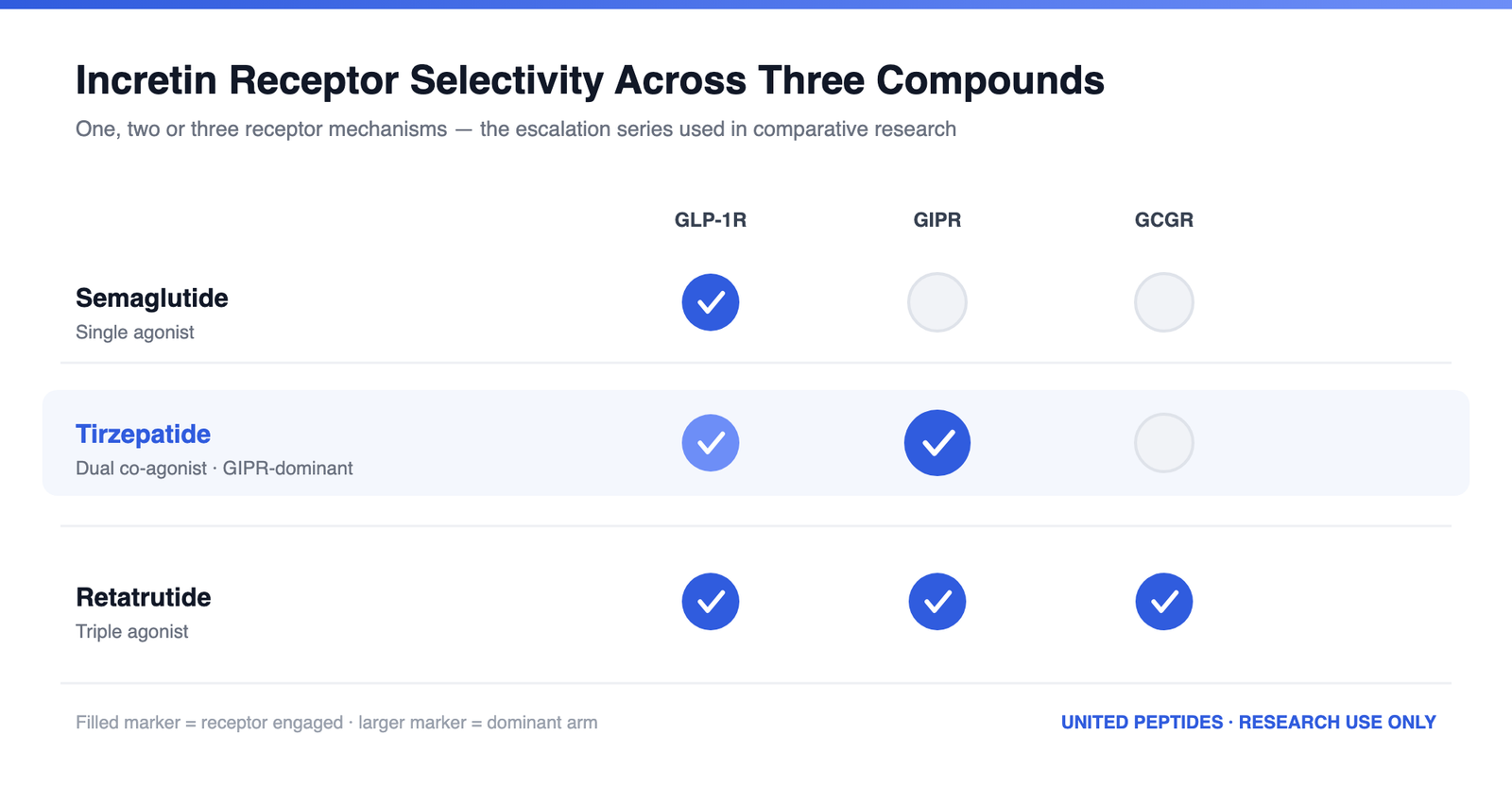
The research value of a selective agonist lies in what it excludes. A study using Semaglutide isolates GLP-1R-mediated effects with no confounding contribution from GIP or glucagon receptor signalling. That makes it the natural single-receptor control in any design asking what a dual or triple agonist adds beyond GLP-1R engagement.
Where a study compares Semaglutide against Tirzepatide, the comparison isolates the contribution of GIPR co-agonism specifically, because GLP-1R engagement is present in both arms. That is a considerably cleaner question than comparing an incretin agonist against an unrelated compound.
Molecular Profile
| Compound class | Synthetic GLP-1 receptor agonist analogue (single receptor) |
| Receptor target | GLP-1R only |
| CAS number | 910463-68-2 |
| Molecular formula | C187H291N45O59 |
| Molecular weight | Approximately 4,114 Da |
| Amino acid length | 31 residues |
| Key modifications | Aib substitution at position 8 (DPP-4 resistance); C18 fatty diacid side chain via linker (albumin binding) |
| Agonism profile | Selective, single-receptor; no measurable GIPR or GCGR activity |
| Supplied format | Sealed pre-filled research pen unit |
| Purity | HPLC-verified at 99% or better, peptide content |
Investigators should treat published receptor affinity figures as assay-dependent indicators rather than fixed constants. Reported values vary with cell line, receptor expression density, readout system and equilibration time. Where a study depends on a precise potency figure, establish it in-house under the study’s own conditions.
Why It Became the Reference Single Agonist
Three properties explain Semaglutide’s position in the literature.
Stability. The Aib substitution at position 8 blocks DPP-4 cleavage, the primary route by which native GLP-1 is inactivated within minutes. This is what turns a short-lived endogenous peptide into a workable experimental tool.
Albumin binding. The C18 fatty diacid side chain promotes reversible albumin association, extending circulatory residence and flattening the exposure profile relative to unmodified GLP-1. For research purposes this produces a more consistent receptor exposure than a rapidly cleared analogue.
Selectivity. The compound engages one receptor. In a field that has moved toward multi-receptor agonism, a clean single-receptor agonist is the instrument that makes the broader question answerable.
Formulation History and What It Changed
The clinically significant formulation development around Semaglutide was oral delivery, using an absorption enhancer to achieve measurable bioavailability from a tablet. That work matters to researchers not as a therapeutic milestone but as an example of how much molecular behaviour can be altered by delivery route independent of receptor pharmacology.
Equivalent exposure delivered by different routes is not necessarily equivalent at the receptor, and studies comparing routes should treat delivery as a variable rather than a presentation detail. Where a comparison spans formulations, exposure profiling is required before any receptor-level effect can be attributed to the molecule rather than to its delivery.
The Incretin Escalation Series
The clearest way to locate Semaglutide in the current research landscape is as the first step in a three-point escalation series, where each step adds exactly one receptor mechanism.
| One receptor | Semaglutide – GLP-1R selective | Isolates baseline GLP-1 signalling |
| Two receptors | Tirzepatide – GIPR and GLP-1R, GIPR-dominant | Adds GIP receptor co-agonism |
| Three receptors | Retatrutide – GLP-1R, GIPR and GCGR | Adds glucagon receptor agonism |
This structure is why incretin research is unusually tractable as a comparative field. Each compound’s marginal contribution can be isolated by differencing against the step below it, with receptor selectivity as the only systematic variable.
The Tirzepatide versus Semaglutide comparison published in the New England Journal of Medicine is the reference point for the single-versus-dual contrast, and the comparative cardiometabolic review covering Semaglutide, Liraglutide and Tirzepatide places the class in a single frame.
Comparative Research Designs
Against a dual agonist (the GIPR question). Both compounds engage GLP-1R. The difference is the GIPR arm. Differencing results isolates what GIP receptor co-agonism contributes to the integrated response, without the confounding of an unrelated comparator.
Against a triple agonist (the GCGR question). Semaglutide as baseline, Tirzepatide as the dual step, Retatrutide as the triple step. Each difference isolates one receptor mechanism.
As a single-receptor control in mechanism studies. Where the research question concerns whether an observed effect is incretin-mediated at all, a selective GLP-1 agonist establishes the GLP-1R contribution before any broader claim is made.
Against co-administered agonists. A dual agonist delivered as one molecule versus two separate agonists in sequence tests whether ratio-locked concurrent activation differs from simultaneous independent activation – a question no single-receptor compound can answer alone, but which requires one as a control.
Purity, Batch Identity and Analytical Verification
Semaglutide’s two engineered features are the ones most likely to be lost in a poorly controlled synthesis. The Aib substitution and the C18 diacid side chain both need to be present for the molecule to behave as the literature describes.
Request a lot-specific certificate of analysis with an HPLC purity figure stated as peptide content, and mass spectrometry confirmation that the expected molecular mass is intact. HPLC alone cannot reliably distinguish the target from a variant missing its side chain if the two elute similarly. Every batch released is backed by an independent laboratory report, and the full documents are published against their lot numbers in our Certificate of Analysis gallery.
| Purity | HPLC, reported as peptide content rather than combined area percentage |
| Identity | Mass spectrometry confirming expected mass, fatty acid side chain intact |
| Batch linkage | Lot number on the certificate matching the lot on the units supplied |
| Format | Stated strength matching the sealed unit label and the certificate |
Method transferability between analytical approaches is a recurring source of cross-study inconsistency. The peptide purification transferability review in the Journal of Peptide Science is a useful reference on how analytical figures behave when methods change.
Storage and Handling
Sealed research units should be stored cold, dark and dry, typically around -20 degrees C, with a consistent temperature and no unnecessary cycling.
Log the date material entered storage and the date it was opened. Keep lot documentation with the material rather than in a separate file. Where a study spans more than one lot, treat lot identity as an experimental variable and report it – an inter-batch difference misread as a biological effect is a real and avoidable failure mode in incretin work.
Where units remain sealed until use, the handling burden is minimal, which is a genuine argument for sealed format in multi-arm comparative studies: fewer preparation variables, fewer opportunities for handling error to enter the dataset.
Where United Peptides Fits
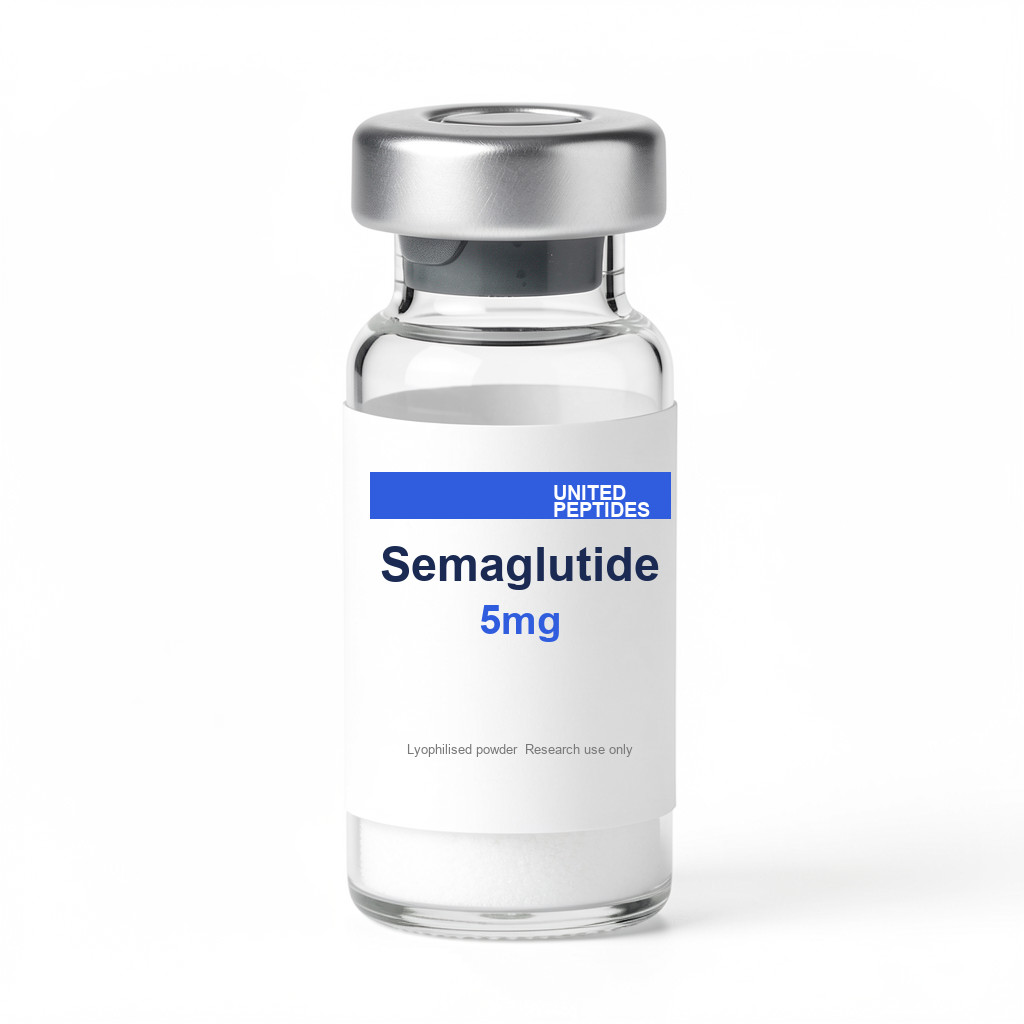
United Peptides supplies Semaglutide 5mg as sealed pre-filled research pen units with batch documentation, HPLC-verified at 99% or better, dispatched from the UK strictly for laboratory research use.
For the dual-agonist comparison arm, Tirzepatide 60mg provides the GIPR/GLP-1R step. For the triple-agonist arm, Retatrutide 40mg completes the series. Sourcing and price comparison for the single-receptor arm are covered in Where to Buy Semaglutide UK and Semaglutide UK Price Guide.
Research Use Only
All products referenced in this article are supplied strictly for laboratory research use only (RUO). They are not medicines, not supplements, and not for human or veterinary use. They must not be administered to humans or animals, and they are not intended for diagnostic or therapeutic purposes. Purchasers must be 18 or older, UK-based, and buying for legitimate scientific research.
United Peptides supplies HPLC-verified, batch-documented research material. Browse the full range under research peptides.
Ready to compare documentation before you order?
Every batch we release ships with a lot-specific certificate of analysis you can verify directly with the issuing laboratory.
Frequently Asked Questions
What is Semaglutide used for in research?
Semaglutide is used as a selective GLP-1 receptor agonist – the single-receptor control or baseline arm in incretin-pathway studies examining what GIP or glucagon receptor co-agonism adds on top of GLP-1 signalling.
What makes Semaglutide different from other incretin compounds?
It is selective. Semaglutide engages GLP-1R only, with no measurable GIP or glucagon receptor activity. Dual and triple agonists engage two or three receptors, which makes them useful for different questions but unsuitable as a clean single-receptor baseline.
What modifications make Semaglutide stable?
An Aib substitution at position 8, which blocks DPP-4 enzymatic cleavage, and a C18 fatty diacid side chain attached via a linker, which promotes albumin binding and extends circulatory residence relative to native GLP-1.
Is Semaglutide approved for human use?
Semaglutide has been approved as a therapeutic in some jurisdictions for specific clinical indications, but material supplied by United Peptides is sold strictly for laboratory research use only, is not a medicine, and is not intended for human or veterinary use or for diagnostic or therapeutic purposes.
Why is Semaglutide the standard comparator for Tirzepatide?
Both compounds engage GLP-1R, so comparing them isolates the contribution of GIP receptor co-agonism specifically. Comparing a dual agonist against an unrelated compound would confound the receptor question with unrelated differences.