

Tirzepatide is the molecule that forced a rewrite of incretin pharmacology. It is a single synthetic peptide chain engineered to activate two receptors at once – the glucose-dependent insulinotropic polypeptide receptor (GIPR) and the glucagon-like peptide-1 receptor (GLP-1R) – and in doing so it became the first successful dual incretin co-agonist to reach clinical use.
For research groups working on metabolic signalling, tirzepatide matters less as a therapeutic and more as a structural proof: that a single backbone can be tuned to engage two Class B G-protein-coupled receptors with deliberately unequal potency, and that the resulting signalling profile differs measurably from co-administering two separate agonists. Understanding that design logic is the starting point for almost any tirzepatide protocol.
What Is Tirzepatide?
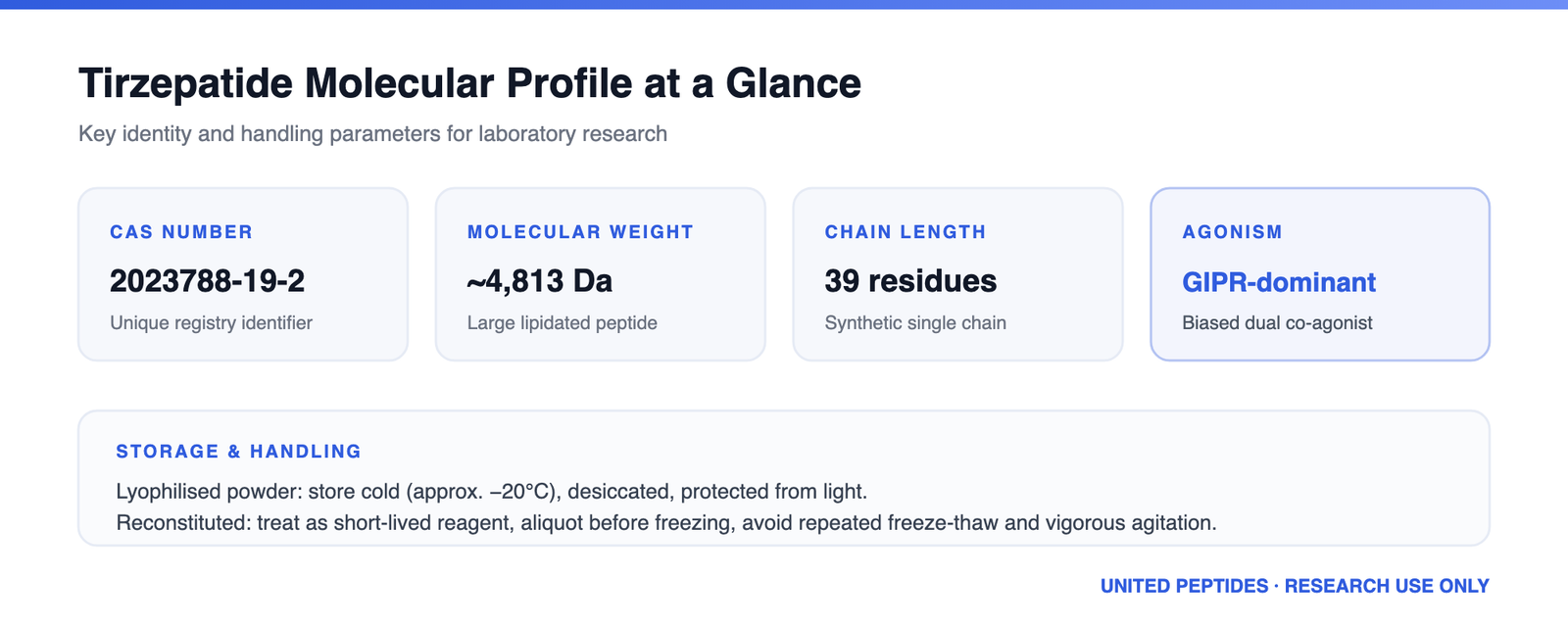
Tirzepatide (CAS 2023788-19-2, molecular formula C225H348N48O68) is a synthetic 39-amino-acid peptide investigated as a dual GIP/GLP-1 receptor co-agonist – a category the literature frequently refers to as a “twincretin” because it engages two incretin pathways from one molecule.
The compound was not designed by combining two existing drugs. It was engineered by introducing GLP-1 receptor activity into a GIP-based peptide sequence, then optimising that hybrid backbone for metabolic stability. The result is a molecule that binds GIPR with affinity comparable to native GIP, while binding GLP-1R at roughly five-fold weaker affinity than native GLP-1. That asymmetry is deliberate, and it is the single most important structural fact about the compound.
Tirzepatide is an imbalanced and biased dual agonist – imbalanced in that it favours GIPR over GLP-1R, and biased in that it does not activate both receptors to the same degree. Any research design that treats it as “two agonists in one vial” misreads the pharmacology.
United Peptides supplies tirzepatide as a lyophilised research-grade solid for laboratory investigation at Tirzepatide 60mg.
How It Works
Tirzepatide’s research relevance comes from engaging two receptors that act through overlapping but non-identical signalling routes. The value of a single molecule hitting both is not additive pharmacology – it is the distinct, integrated response that concurrent biased activation produces.
GIP Receptor Engagement
The GIPR arm is the dominant one. GIP receptors are expressed on pancreatic beta cells, on adipocytes, and in hypothalamic and hindbrain regions involved in energy balance regulation. GIPR activation potentiates glucose-dependent insulin secretion with a kinetic profile distinct from GLP-1R-driven secretion, and is implicated in lipid handling within adipose tissue.
The GIP story reversed over roughly a decade of research. Early rodent work framed GIPR agonism as a liability – a driver of fat accumulation – and the assumption shaped drug design for years. Data from dual-agonist human trials overturned it, establishing GIPR co-agonism as a productive component of combined incretin therapy rather than a problem to be avoided. Tirzepatide is the compound that forced that revision, which is why its GIPR arm carries disproportionate research interest.
GLP-1 Receptor Engagement
The GLP-1R arm contributes the better-characterised of the two signalling pathways. GLP-1 receptors are expressed on vagal afferent neurons and within hypothalamic nuclei including the arcuate nucleus. Receptor activation in that region is associated with reduced neuropeptide Y expression alongside increased pro-opiomelanocortin activity – a modelled shift toward reduced energy intake. GLP-1R activation also slows gastric emptying through vagal efferent pathways.
What makes tirzepatide unusual is that this arm is deliberately the weaker one. Native GLP-1 binds GLP-1R more tightly than tirzepatide does. The molecule reaches its effect through a GIPR-dominant balance that no co-administration protocol of two separate agonists reproduces – because two separate molecules cannot be tuned to hit their targets at the same fixed ratio in every tissue.
Why One Molecule Changes the Experiment
Co-administering a GIP agonist and a GLP-1 agonist does not replicate tirzepatide. Two separate compounds distribute differently, clear at different rates, and reach individual tissues in ratios that drift over time. A single dual-agonist chain delivers both activities with a fixed intramolecular ratio that stays constant as the molecule distributes.
That distinction is the core experimental rationale for using tirzepatide as a tool compound. It lets investigators isolate questions of concurrent, ratio-locked receptor activation from questions of dose scheduling and pharmacokinetic mismatch.
Molecular Profile
| Compound class | Synthetic dual GIP/GLP-1 receptor co-agonist peptide (“twincretin”) |
| Receptor targets | GIPR (dominant), GLP-1R |
| Agonism profile | Imbalanced and biased; GIPR-selective over GLP-1R |
| CAS number | 2023788-19-2 |
| Molecular formula | C225H348N48O68 |
| Molecular weight | ~ 4,813 Da |
| Amino acid length | 39 residues |
| Modification | C20 fatty diacid moiety via linker for albumin binding and extended half-life |
| Supplied form | Lyophilised (freeze-dried) powder, research-use-only |
| Purity | >=99% verified by HPLC, per batch |
| Solubility | Soluble in aqueous diluents typically used for laboratory peptide reconstitution |
| Literature category | Dual incretin co-agonist; GIP/GLP-1 metabolic research peptide |
Incretin Pathway Research
Both receptor targets are Class B G-protein-coupled receptors that signal primarily through G-alpha-s, activating adenylate cyclase, raising intracellular cyclic AMP, and driving protein kinase A activity. The downstream phosphorylation targets diverge by tissue: enhanced insulin secretion in pancreatic beta cells, activation of hormone-sensitive lipase in adipocytes, and modulation of feeding circuits in the hypothalamus and hindbrain.
Because tirzepatide engages both receptors with a fixed potency ratio, it is used in research settings to examine questions that separate-agonist designs cannot cleanly address: whether GIPR-dominant co-activation produces effects beyond what GLP-1R agonism alone achieves, and how the GIPR arm modifies outcomes normally attributed to incretin signalling in general.
Reported receptor affinity values place tirzepatide at approximately native-GIP-equivalent affinity for GIPR and roughly five-fold weaker affinity at GLP-1R relative to native GLP-1. Investigators should treat published affinity figures as assay-dependent rather than as fixed constants – EC50 values vary substantially with cell line, receptor density, and readout system.
Primary literature is indexed on PubMed, and receptor-level binding and bias data are catalogued at IUPHAR/BPS Guide to Pharmacology. Both are worth consulting before fixing potency assumptions into a protocol.
Receptor Signalling and the cAMP Pathway
Both GIPR and GLP-1R couple to G-alpha-s, and both therefore raise intracellular cyclic AMP when activated. That shared second messenger is why the two pathways are often described as redundant. The description is imprecise. Downstream of cAMP, the phosphorylation targets diverge by tissue and by receptor: PKA-mediated potentiation of glucose-stimulated insulin secretion in pancreatic beta cells, hormone-sensitive lipase activation in adipocytes, and modulation of neuropeptide expression in hypothalamic feeding circuits.
Where the receptors differ is in their tissue distribution, their desensitisation kinetics, and their downstream effector recruitment. GIPR and GLP-1R are not co-expressed at identical densities in every relevant tissue, which means a fixed intramolecular potency ratio produces a tissue-by-tissue activation profile that no single-receptor agonist can produce. This is the mechanistic reason tirzepatide’s effects are not simply the sum of a GIP agonist plus a GLP-1 agonist.
Investigators using beta-arrestin recruitment assays should note the “biased agonism” designation in the literature: tirzepatide does not necessarily recruit the same downstream effectors as native GIP at GIPR, even where binding affinity is comparable. Binding affinity and functional potency are separate measurements and should be reported separately in comparative work.
Receptor Affinity and Assay Variance
Published affinity and potency values for tirzepatide at both receptors vary substantially between studies. Reported EC50 values depend on cell line, receptor expression density, the specific readout (cAMP accumulation versus beta-arrestin recruitment versus downstream reporter activation), and the assay’s equilibration time.
For comparative protocols, this means published affinity figures should be treated as relative indicators rather than absolute constants. A design that requires precise potency ratios should establish them in-house under the study’s own conditions rather than citing literature values as fixed parameters. Where a study compares tirzepatide against a selective GLP-1 agonist, the more defensible approach is to characterise both compounds under identical assay conditions.
Tirzepatide Compared With Other Incretin Compounds
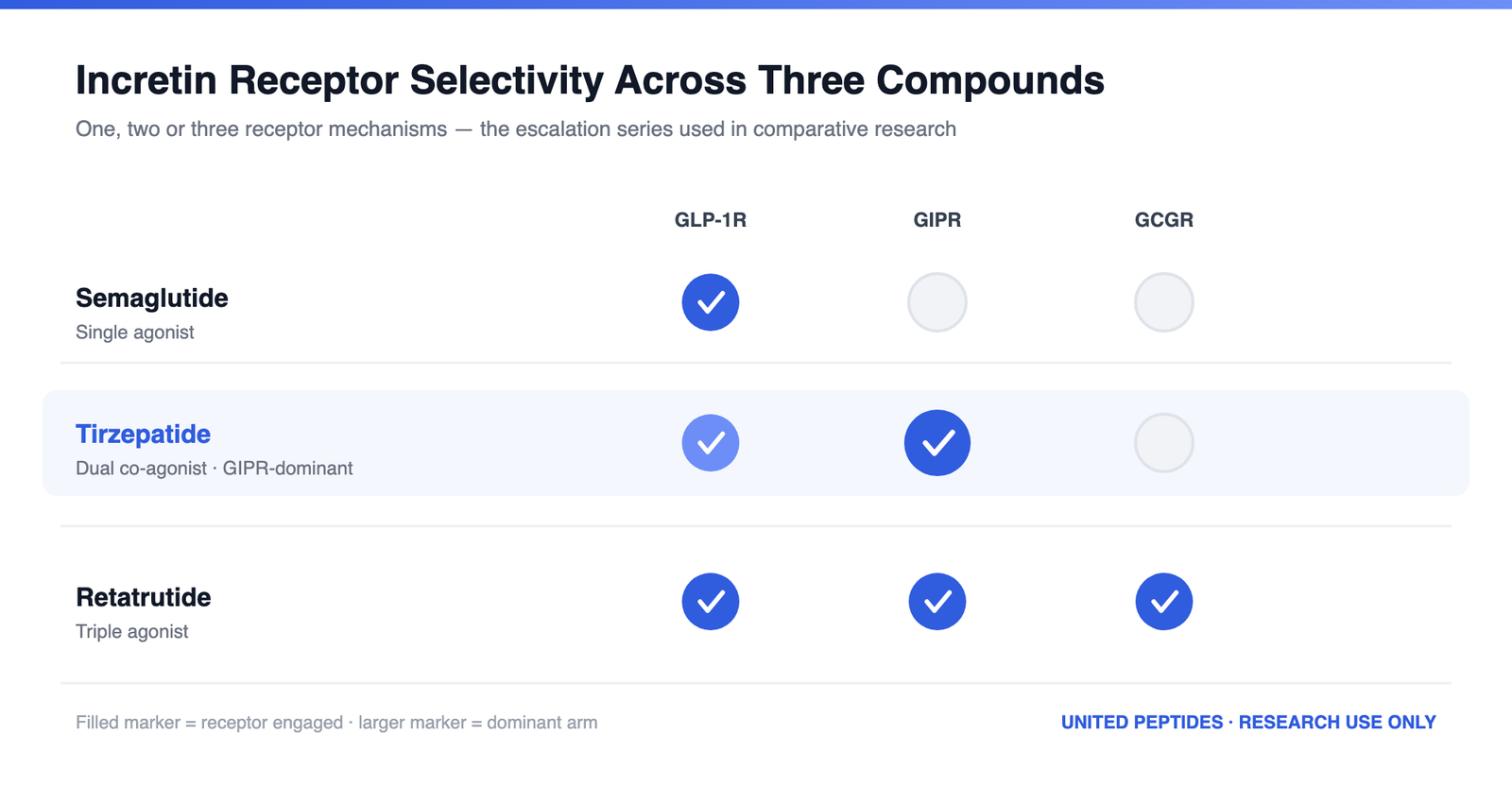
The clearest way to understand tirzepatide’s research niche is to place it against the other two incretin-pathway compounds commonly studied alongside it.
Tirzepatide vs Semaglutide
Semaglutide is a selective GLP-1 receptor agonist – it engages one receptor. Tirzepatide engages two. For researchers asking what the GIPR arm adds on top of GLP-1R activation, semaglutide is the natural single-receptor control. A comparative design using both isolates the contribution of GIPR co-agonism rather than confounding it with general incretin effects.
United Peptides supplies Semaglutide 5mg for this kind of single-receptor comparator work.
Tirzepatide vs Retatrutide
Retatrutide is a triple agonist, adding glucagon receptor (GCGR) agonism on top of GIP and GLP-1 activity. The GCGR arm introduces a thermogenic and hepatic energy-expenditure component that neither dual nor single agonists provide. Tirzepatide therefore functions as the two-receptor step in a clean escalation series: one receptor (semaglutide), two receptors (tirzepatide), three receptors (retatrutide).
That three-point series is one of the more useful comparative designs available in incretin research, because each step adds exactly one receptor mechanism. Retatrutide 20mg and Retatrutide 40mg are available for the triple-agonist arm of such studies.
Designing a Comparative Protocol
Tirzepatide’s greatest research value is comparative. Used in isolation it is simply a dual agonist; used against the right controls it becomes a probe for what each receptor arm contributes. A few design considerations follow from the pharmacology.
Matching Conditions Across Compounds
Where a study compares tirzepatide against a selective GLP-1 agonist or a triple agonist, all compounds should be characterised under identical assay conditions. Because published potency values vary so widely by readout, cross-study figures cannot be mixed into a single comparative claim. Reconstitute each compound in the same diluent, at the same working concentration range, and run them in the same plate where practical.
Selecting the Right Control Arm
The control arm determines what question the study can answer. A selective GLP-1 agonist as control isolates the contribution of GIPR co-agonism specifically. A triple agonist as control isolates what the glucagon receptor arm adds on top of dual agonism. Studies that want to separate “incretin effect” from “GIPR-specific effect” need the single-receptor control; studies examining thermogenic contribution need the triple-agonist control.
Interpreting Co-Agonism Results
Because tirzepatide’s ratio is fixed, results cannot be attributed to dose scheduling. This removes a confounding variable but adds an interpretive constraint: effects observed are properties of the ratio-locked combination, not of either receptor considered separately. Reporting should distinguish between effects attributable to the GIPR-dominant profile and effects attributable to concurrent activation in general.
Analytical Verification Before Study
Before committing a batch to a comparative protocol, verify identity and purity on the specific lot. Mass spectrometry confirmation establishes that the fatty-acid modification is intact, and HPLC establishes peptide content. A batch that purifies cleanly but has lost its lipid moiety will behave differently in solution, which can present as an unexplained deviation from published behaviour rather than as an obvious analytical failure.
Record the lot number against every experimental result. Where a study spans multiple batches, treat batch identity as a variable and report it – otherwise an inter-batch difference can be misread as a biological effect.
Research-Grade Sourcing
Purity documentation is the variable that most often determines whether a tirzepatide study is reproducible. The compound is large, carries a fatty-acid modification, and its synthesis generates byproducts – incomplete deprotection products and truncated sequences – that can co-elute in ways a single analytical run will not flag.
Request an HPLC trace and mass spectrometry confirmation for the specific lot under investigation. Verify that the reported purity refers to peptide content rather than a combined area percentage, and confirm that the albumin-binding lipid moiety is intact – a molecule that purifies cleanly but has lost its fatty-acid modification behaves differently in solution than the literature describes.
United Peptides supplies tirzepatide at >=99% HPLC-verified purity with batch documentation, available as Tirzepatide 60mg.
Storage & Handling
Lyophilised tirzepatide is stable under standard laboratory storage conditions when kept cold, dry, and protected from light. As with other lipidated peptides, the lyophilised powder is hygroscopic – repeated exposure to ambient humidity is a common and avoidable source of degradation in otherwise well-run studies.
Store the lyophilised powder cold (typically -20 degrees C), desiccated, and away from light. Working aliquots taken from the bulk vial should be handled with dedicated, dry equipment.
Once reconstituted, tirzepatide solutions should be treated as short-lived laboratory reagents rather than long-term stock. The fatty-acid modification that extends the molecule’s behaviour in biological systems does not confer indefinite stability in aqueous solution, and repeated freeze-thaw cycling of reconstituted material is generally avoided in published handling protocols.
Aliquot before freezing. Work with the smallest practical volumes. Record the reconstitution date on every tube, and avoid vigorous agitation or vortexing – large modified peptides are susceptible to aggregation and surface adsorption when handled aggressively.
Frequently Asked Questions
What is tirzepatide used for in research?
Tirzepatide is investigated as a tool compound for studying concurrent, ratio-locked GIP and GLP-1 receptor activation, particularly in incretin-pathway pharmacology, energy-balance models, and biased-agonism research where receptor selectivity is a controlled variable.
What does “imbalanced and biased dual agonist” mean?
It means tirzepatide does not activate both of its target receptors equally. It binds GIPR with roughly native-GIP affinity but binds GLP-1R around five-fold more weakly than native GLP-1. The molecule is GIPR-dominant, and that imbalance is a designed feature rather than a limitation.
Is tirzepatide the same as combining GIP and GLP-1 agonists?
No. Co-administering two separate agonists distributes and clears them at different rates, so the ratio reaching each tissue drifts over time. A single dual-agonist chain delivers both activities at a fixed ratio. The two designs are not pharmacologically interchangeable.
How does tirzepatide differ from semaglutide?
Semaglutide is a selective GLP-1 receptor agonist engaging one receptor. Tirzepatide engages both GIPR and GLP-1R. Semaglutide is therefore the standard single-receptor comparator when isolating the contribution of GIPR co-agonism.
How does tirzepatide differ from retatrutide?
Retatrutide is a triple agonist, adding glucagon receptor agonism to GIP and GLP-1 activity. The GCGR arm contributes a thermogenic and hepatic energy-expenditure component that dual agonists do not provide.
How should tirzepatide be stored in the laboratory?
Lyophilised powder stored cold (typically -20 degrees C), desiccated and protected from light. Once reconstituted, handle as a short-lived reagent, avoid repeated freeze-thaw cycles, avoid vigorous agitation, and record reconstitution dates on every aliquot.
Is tirzepatide approved for human use?
Tirzepatide has been approved as a therapeutic in some jurisdictions for specific clinical indications. However, material supplied by United Peptides is sold strictly for laboratory research use only, is not intended for human or veterinary use, and is not for diagnostic or therapeutic purposes.
Moving Forward
The research case for tirzepatide rests on a structural argument rather than a commercial one. Its GIPR-dominant, ratio-locked dual agonism produces signalling dynamics that separate-agonist protocols cannot replicate, and those dynamics are what made the compound a reference point in modern incretin pharmacology. It sits at the centre of a clean escalation series – one receptor, two receptors, three – that makes it unusually valuable as a controlled experimental tool.
United Peptides supplies Tirzepatide 60mg as HPLC-verified, research-use-only material with batch documentation. For the broader incretin comparison series, Semaglutide 5mg provides the single-receptor arm and Retatrutide 20mg plus Retatrutide 40mg provide the triple-agonist arm.
All products are supplied strictly for laboratory research use only (RUO). Not for human or veterinary use. Not for diagnostic or therapeutic purposes. You must be 18 or older, UK-based, and purchasing for scientific research.
Browse the full research peptides range, or compare our Tirzepatide 60mg and Retatrutide 40mg listings.