

Semaglutide vs Tirzepatide is not a contest between a weaker and a stronger compound. It is a comparison between a selective single-receptor GLP-1 agonist and a GIPR-dominant dual agonist, and the difference determines which experimental question each compound can answer. This article sets out the mechanistic distinction, the comparative data, and how to choose between them for a research design.
The Core Distinction: One Receptor vs Two
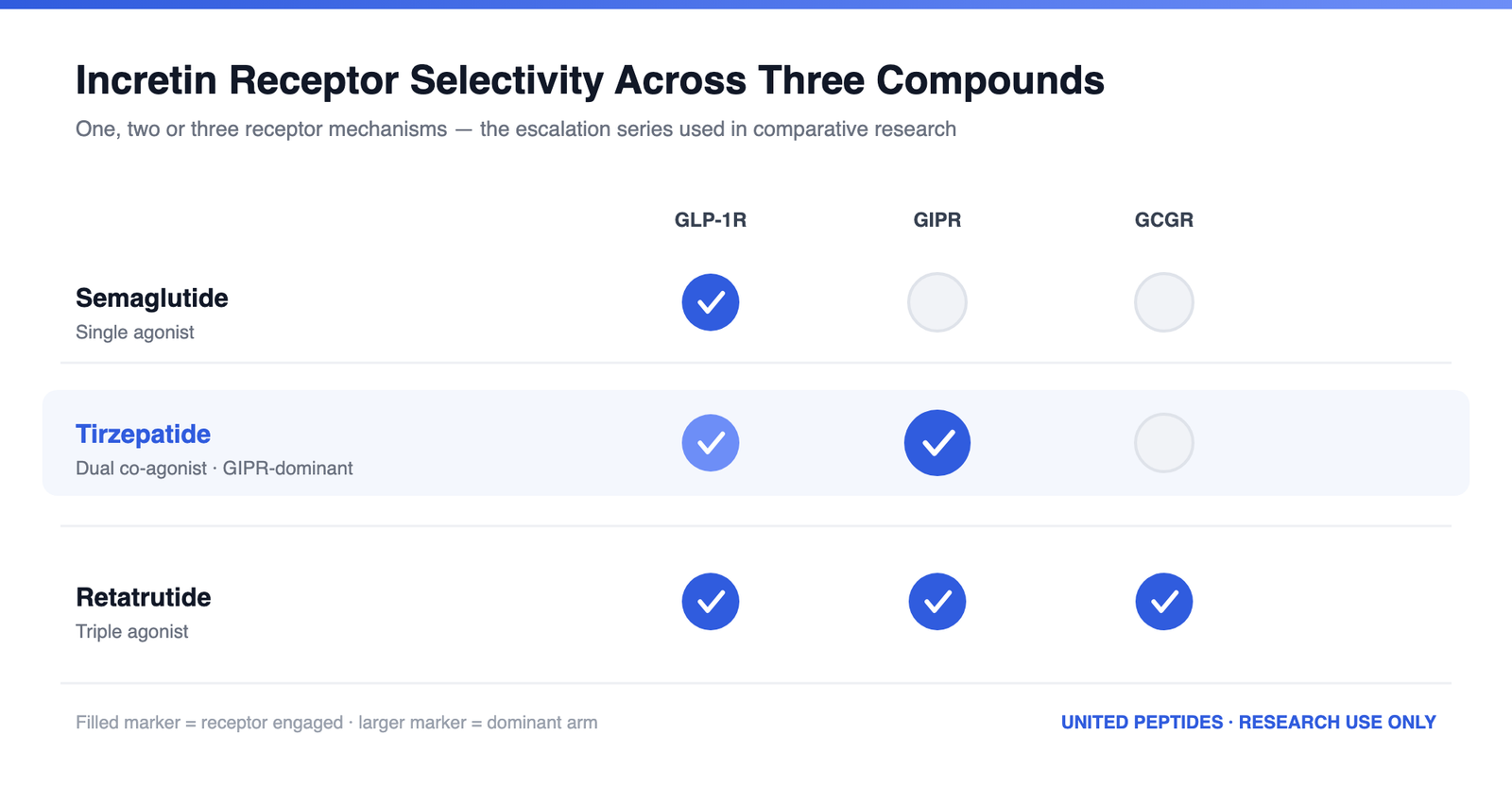
Semaglutide is a 31-amino-acid GLP-1 receptor agonist analogue. It engages one receptor: GLP-1R. Its two engineered modifications – an Aib substitution at position 8 conferring DPP-4 resistance, and a C18 fatty diacid side chain conferring albumin binding – extend its stability and residence without broadening its receptor profile.
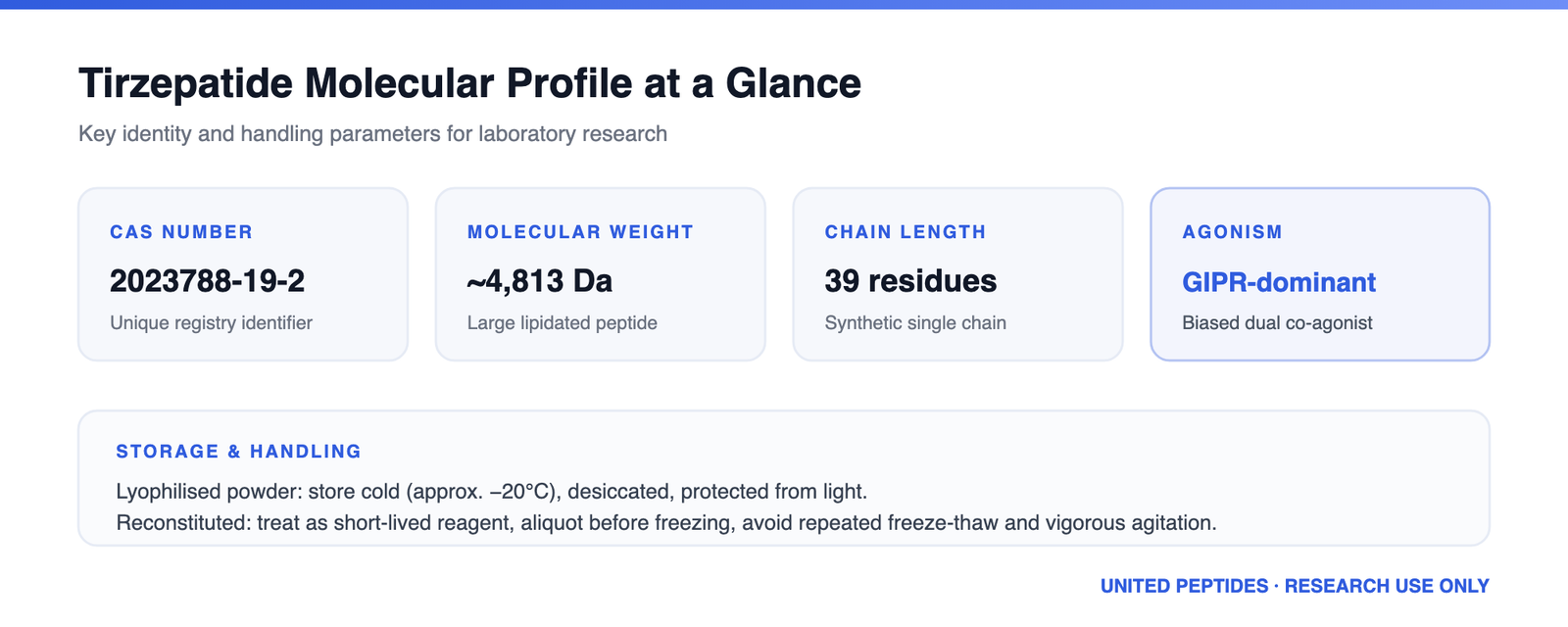
Tirzepatide is a 39-amino-acid dual agonist engaging two receptors: the glucose-dependent insulinotropic polypeptide receptor (GIPR) and GLP-1R. Critically, it is not a balanced dual agonist. It binds GIPR with approximately native-GIP affinity while binding GLP-1R at roughly five-fold weaker affinity than native GLP-1. It is GIPR-dominant, imbalanced and biased.
That asymmetry is the single most important structural fact about the compound, and it is the reason Tirzepatide is not simply “Semaglutide plus a second receptor”.
Molecular Comparison
| Compound class | Semaglutide: GLP-1R selective agonist | Tirzepatide: GIPR/GLP-1R dual co-agonist |
| Receptors engaged | GLP-1R only | GIPR (dominant) and GLP-1R |
| Agonism profile | Selective, single receptor | Imbalanced and biased; GIPR-selective |
| Amino acid length | 31 residues | 39 residues |
| Molecular weight | Approximately 4,114 Da | Approximately 4,813 Da |
| Key modification | Aib substitution; C18 fatty diacid side chain | C20 fatty diacid moiety via linker |
| Research role | The single-receptor control arm | Isolates the GIPR co-agonist contribution |
Reported affinity and potency values for both compounds vary substantially with cell line, receptor expression density, readout system and assay equilibration time. Where a study depends on a precise potency ratio, establish it in-house under the study’s own conditions rather than citing literature figures as constants.
Both receptors are Class B G-protein-coupled receptors that couple to G-alpha-s, raising intracellular cyclic AMP and driving protein kinase A activity. That shared second messenger leads to the two pathways being described as redundant. The description is imprecise.
Downstream of cAMP, the targets diverge by tissue and by receptor: PKA-mediated potentiation of glucose-stimulated insulin secretion in pancreatic beta cells, hormone-sensitive lipase activation in adipocytes, and modulation of neuropeptide expression in hypothalamic feeding circuits – reduced neuropeptide Y alongside increased pro-opiomelanocortin activity in the models studied.
GIPR and GLP-1R are not co-expressed at identical densities across tissues
A fixed intramolecular potency ratio therefore produces a tissue-by-tissue activation profile that no single-receptor agonist reproduces. This is the mechanistic reason Tirzepatide’s effects are not simply the sum of a GLP-1 agonist plus a GIP agonist.

Why One Molecule Is Not Two Co-Administered Agonists
A frequent assumption is that Tirzepatide’s dual activity can be replicated by giving a GLP-1 agonist and a GIP agonist together. It cannot, and the reason is pharmacokinetic rather than pharmacological.
Two separate molecules distribute differently, clear at different rates, and reach individual tissues in ratios that drift over time. A single dual-agonist chain delivers both activities at a fixed intramolecular ratio that stays constant as the molecule distributes. The two designs are not interchangeable, and a study treating them as equivalent would confound the ratio-locking question with a dosing-schedule artefact.
For research purposes this makes the single-molecule design valuable precisely because it removes a variable. Effects observed are properties of the ratio-locked combination rather than of any particular dosing schedule.
What the Comparative Evidence Shows
The direct clinical comparison between the two compounds is the Tirzepatide versus Semaglutide head-to-head trial published in the New England Journal of Medicine, which established the dual agonist as outperforming the selective GLP-1 agonist on the trial’s glycaemic endpoint.
Longer-term maintenance data for the dual agonist is documented in the SURMOUNT-4 continuation trial published in JAMA, and longer-term cardiometabolic biomarker changes from the SURMOUNT-1 programme are reported in a post hoc analysis in the Journal of the American College of Cardiology.
On the single-receptor side, once-weekly Semaglutide’s profile was established in the STEP programme trial published in the New England Journal of Medicine, with the class placed in a single comparative frame by a cardiometabolic review covering Semaglutide, Liraglutide and Tirzepatide.
Choosing Between Them for a Research Design
The choice follows the question, not the potency figures.
| Isolating GLP-1R effects | Semaglutide | Engages one receptor, so results are attributable to GLP-1 signalling alone |
| Testing what GIPR co-agonism adds | Tirzepatide plus Semaglutide control | Both arms share GLP-1R engagement, so the difference isolates the GIPR arm |
| Establishing a class baseline | Semaglutide | The reference single-receptor comparator for the whole incretin field |
| Ratio-locked concurrent activation | Tirzepatide | Fixed intramolecular ratio cannot be reproduced by co-administration |
| Triple-receptor escalation | Add Retatrutide as the third step | One receptor, two receptors, three – each step adds one mechanism |
The escalation series is the cleanest comparative structure available in incretin research precisely because each step adds exactly one receptor mechanism. Semaglutide is the baseline, Tirzepatide the two-receptor step, and a triple agonist the three-receptor step. The Phase 2 Retatrutide trial and the Retatrutide systematic review cover the top of that series.
Practical Sourcing Comparison
| Format | Both supplied as sealed pre-filled research pen units |
| Preparation | Neither requires weighing or solvent preparation before use |
| Purity standard | Both HPLC-verified at 99% or better, peptide content |
| Identity testing | Mass spectrometry required for both – each has a lipid modification that can be lost in synthesis |
| Storage | Cold, dark and dry, sealed, with consistent temperature and no unnecessary cycling |
The sourcing discipline is identical for both compounds, and the same documentation standard applies. What differs is the experimental role.
Where United Peptides Fits
United Peptides supplies Semaglutide 5mg as the single-receptor arm and Tirzepatide 60mg as the dual-agonist arm, both as sealed pre-filled research pen units with batch documentation and UK dispatch. The three-receptor step is Retatrutide 40mg. Every batch released is backed by an independent laboratory report, and the full documents are published against their lot numbers in our Certificate of Analysis gallery.
Mechanism context for both compounds is in the Semaglutide Research Guide and the Tirzepatide Research Guide.
Research Use Only
All products referenced in this article are supplied strictly for laboratory research use only (RUO). They are not medicines, not supplements, and not for human or veterinary use. They must not be administered to humans or animals, and they are not intended for diagnostic or therapeutic purposes. Purchasers must be 18 or older, UK-based, and buying for legitimate scientific research.
United Peptides supplies HPLC-verified, batch-documented research material. Browse the full range under research peptides.
Ready to compare documentation before you order?
Every batch we release ships with a lot-specific certificate of analysis you can verify directly with the issuing laboratory.
Frequently Asked Questions
Is Tirzepatide stronger than Semaglutide?
They are not comparable on a single axis. Tirzepatide engages two receptors with a GIPR-dominant profile; Semaglutide engages one. Calling one stronger misreads the pharmacology – each answers a different experimental question about what receptor engagement contributes.
Can Semaglutide be used as a control for Tirzepatide research?
Yes, and it is the standard choice. Both compounds engage GLP-1R, so comparing them isolates the contribution of GIP receptor co-agonism specifically rather than confounding the receptor question with unrelated differences.
Can I replicate Tirzepatide by combining a GLP-1 and a GIP agonist?
No. Two separate molecules distribute and clear at different rates, so the ratio reaching each tissue drifts over time. A single dual-agonist chain delivers both activities at a fixed intramolecular ratio. The designs are not pharmacologically interchangeable.
Is Semaglutide approved for human use?
Semaglutide has been approved as a therapeutic in some jurisdictions for specific clinical indications, but material supplied by United Peptides is sold strictly for laboratory research use only, is not a medicine, and is not intended for human or veterinary use or for diagnostic or therapeutic purposes.
Which compound should I choose for an incretin study?
Follow the question, not the price. Use Semaglutide to isolate GLP-1 receptor effects, and Tirzepatide – with a Semaglutide control – to test what GIP receptor co-agonism adds. Adding a triple agonist extends the design into a clean one-receptor, two-receptor, three-receptor escalation series.