

Tirzepatide 60mg research is concerned with the compound as an experimental tool rather than a therapeutic, and the distinction shapes how a study around it should be built. This reference sets out the parameters worth recording, the analytical checks that establish a batch is fit for purpose, and the comparative designs that make the compound useful rather than merely interesting.
It assumes familiarity with the basics. If the pharmacology is new, start with the Tirzepatide Research Guide.
The Compound as a Research Tool
Tirzepatide’s research value is structural. It is a single synthetic peptide that activates two Class B G-protein-coupled receptors at a fixed intramolecular potency ratio – the glucose-dependent insulinotropic polypeptide receptor (GIPR) and the glucagon-like peptide-1 receptor (GLP-1R). One backbone, two targets, a ratio that does not drift as the molecule distributes.
That fixed ratio is what makes the compound experimentally distinctive
Co-administering a GIP agonist and a GLP-1 agonist does not reproduce it: two separate molecules distribute differently, clear at different rates, and reach individual tissues in proportions that vary over time. A single dual-agonist chain keeps the ratio constant. For studies asking what concurrent, ratio-locked receptor activation produces that sequential or partial activation cannot, that is the entire point.
Identity Parameters Worth Recording
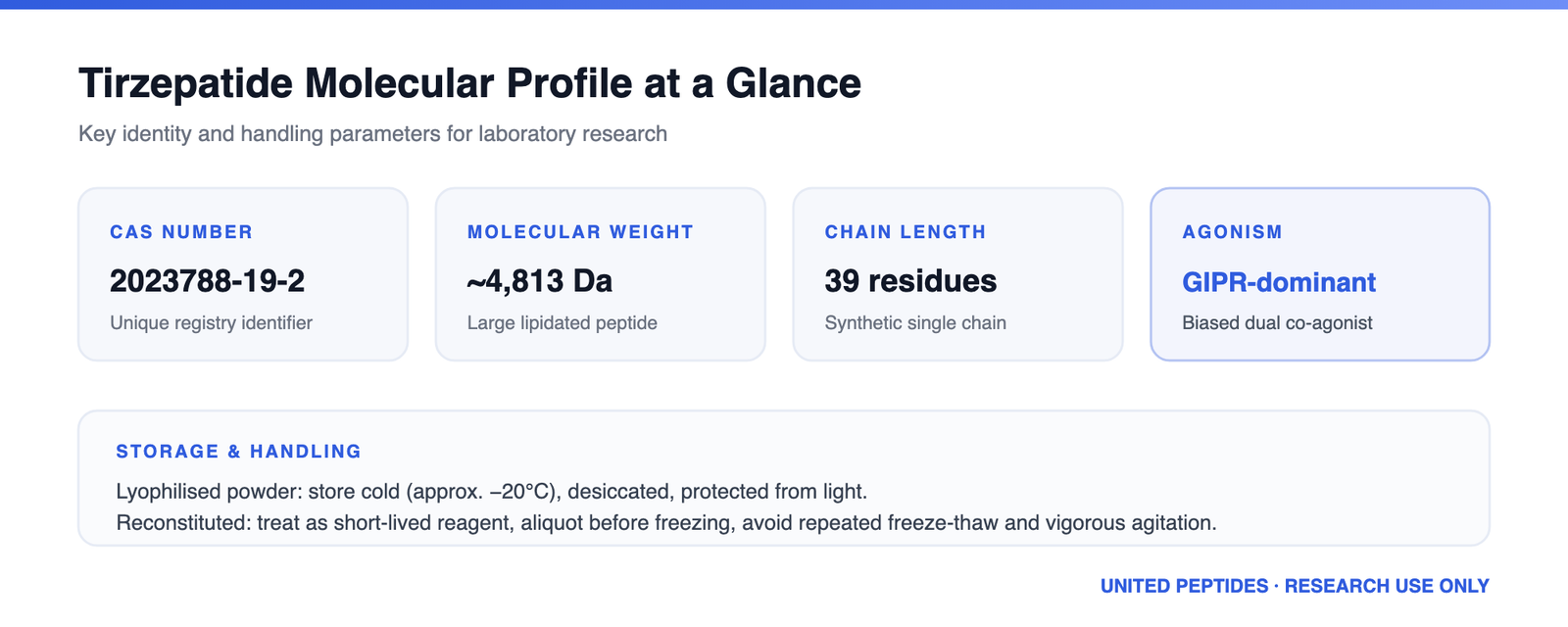
Every published study using a peptide should be able to state what it used precisely. These are the fields that make that possible.
| Compound | Tirzepatide |
| Class | Synthetic dual GIP/GLP-1 receptor co-agonist (twincretin) |
| CAS number | 2023788-19-2 |
| Molecular formula | C225H348N48O68 |
| Molecular weight | Approximately 4,813 Da |
| Amino acid length | 39 residues |
| Key modification | C20 fatty diacid moiety via linker, for albumin binding and extended half-life |
| Receptor targets | GIPR (dominant), GLP-1R |
| Agonism profile | Imbalanced and biased; GIPR-selective over GLP-1R |
| Supplied format | Sealed pre-filled research pen unit |
| Purity | HPLC-verified at 99% or better, peptide content |
Record the lot number against every experimental result
Where a study spans batches, treat lot identity as a variable and report it – otherwise an inter-batch difference can be read as a biological effect.
Analytical Verification Before Experiment
The verification that matters most is the one that catches a de-lipidated batch. HPLC alone cannot distinguish intact Tirzepatide from a variant that has lost its C20 fatty-acid modification but elutes similarly. Mass spectrometry confirmation establishes that the modification survived synthesis.
| Purity | HPLC, reported as peptide content rather than combined area percentage |
| Identity | Mass spectrometry, confirming expected mass with lipid moiety intact |
| Batch linkage | Lot number on the certificate matching the lot on the material supplied |
| Format check | Stated strength matching the certificate for sealed units |
Where a published protocol reports the material’s purity as a controlled variable, the figure in the paper should be traceable to the method used to establish it. A purity number without a stated method is not a comparable figure.
Method transferability between analytical techniques is not trivial, and the HPLC to FPLC transferability review in the Journal of Peptide Science is a useful reference for how analytical figures behave when methods change.
Comparative Designs That Work
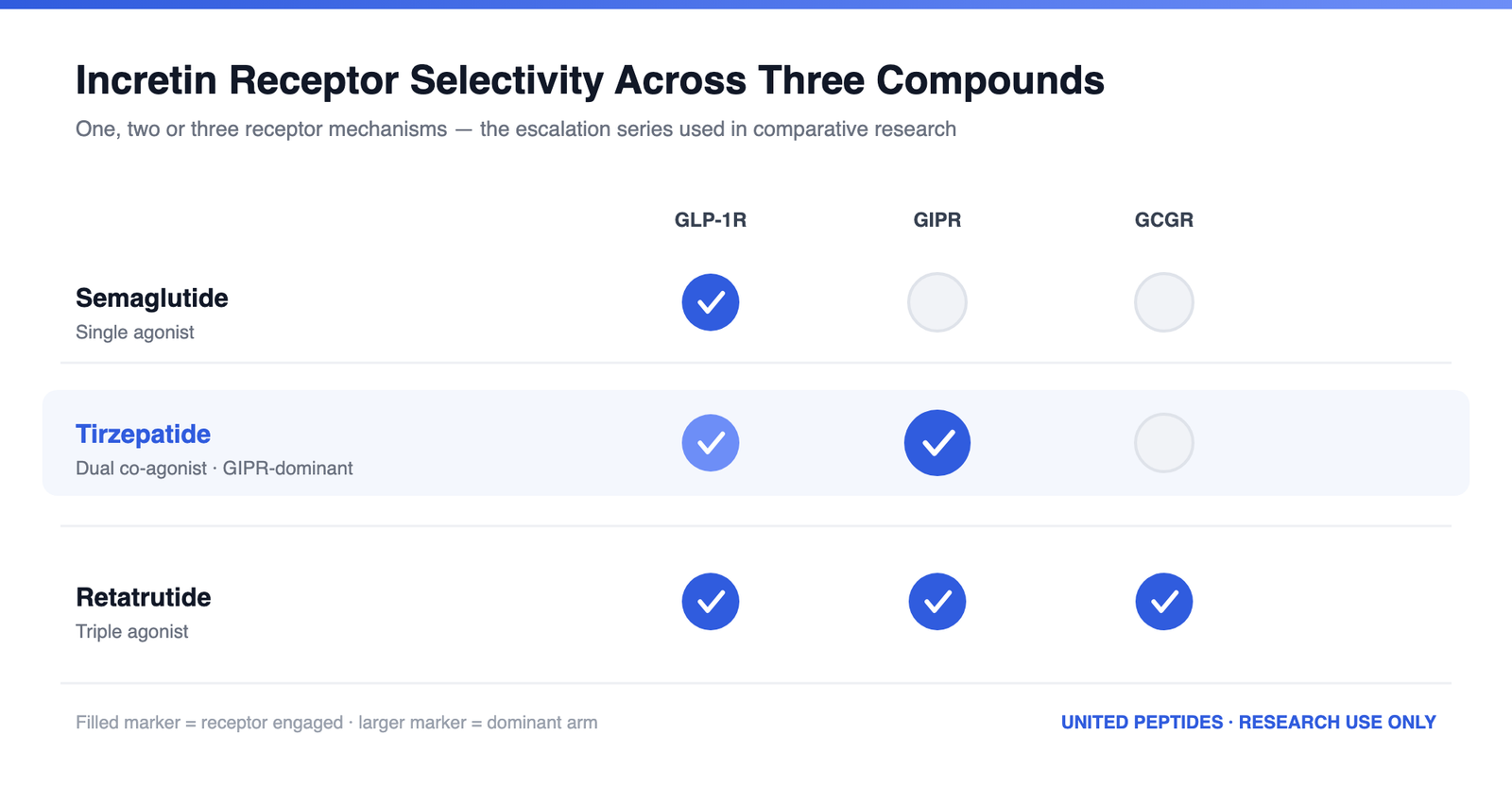
Tirzepatide is at its most useful in a comparative design. In isolation it is a dual agonist; placed against the right controls it becomes a probe for what each receptor arm contributes.
| Against a selective GLP-1 agonist | Isolates the contribution of GIPR co-agonism specifically |
| Against a triple agonist | Isolates what glucagon receptor agonism adds on top of dual agonism |
| Against separate co-administered agonists | Tests whether ratio-locked delivery differs from sequential exposure |
| Against a null control | Establishes baseline for the readout before any receptor question is asked |
The escalation series – one receptor, two receptors, three – is the cleanest comparative structure available in incretin research, because each step adds exactly one receptor mechanism. Tirzepatide is the two-receptor step. The Tirzepatide versus Semaglutide clinical comparison in the New England Journal of Medicine is the reference point for the single-versus-dual contrast, and the comparative cardiometabolic review places the whole class in one frame.
Assay Endpoints Worth Measuring
Both receptor targets couple to G-alpha-s, raising intracellular cyclic AMP. That shared second messenger makes the two pathways look redundant when they are not – downstream targets diverge by tissue and by receptor.
Receptor-level work typically reads cAMP accumulation, beta-arrestin recruitment, or a downstream reporter
Where the question is biased agonism, beta-arrestin recruitment is the more informative readout, because a compound can match native ligand on binding affinity while recruiting a different downstream effector set.
Investigators should report binding affinity and functional potency separately. They are distinct measurements, they respond differently to assay conditions, and conflating them is a recurring source of cross-study disagreement.
Controlling for Assay Variance
Published potency values for Tirzepatide at both receptors vary substantially between studies. Reported EC50 figures depend on cell line, receptor expression density, the specific readout, and assay equilibration time.
For comparative protocols this means published figures should be treated as relative indicators, not absolute constants. A design that depends on a precise potency ratio should establish it in-house under the study’s own conditions, with every compound characterised under identical assay conditions.
Stepwise assay optimisation materially affects reproducibility of GPCR work, and the GIP receptor signalling study in Cell Metabolism is a good example of how much mechanistic detail can turn on readout choice.
Reporting Standards
Three fields are missing from a surprising number of incretin studies: lot number, stated purity method, and format. Each is cheap to record and expensive to reconstruct.
Report the lot number for every batch used. Report purity with the method that established it. Report the format supplied – a sealed pen unit and a bulk lyophilised solid impose different handling and introduce different variables. Where a study spans formats or lots, say so explicitly and treat both as variables rather than background. Every batch released is backed by an independent laboratory report, and the full documents are published against their lot numbers in our Certificate of Analysis gallery.
Where United Peptides Fits
United Peptides supplies Tirzepatide 60mg as sealed pre-filled research units with batch documentation and UK dispatch for laboratory research use only. The single-receptor comparator is Semaglutide 5mg; the triple-agonist arm is Retatrutide 40mg. The compound’s own pharmacology is covered in the Tirzepatide Research Guide.
Research Use Only
All products referenced in this article are supplied strictly for laboratory research use only (RUO). They are not medicines, not supplements, and not for human or veterinary use. They must not be administered to humans or animals, and they are not intended for diagnostic or therapeutic purposes. Purchasers must be 18 or older, UK-based, and buying for legitimate scientific research.
United Peptides supplies HPLC-verified, batch-documented research material. Browse the full range under research peptides.
Ready to compare documentation before you order?
Every batch we release ships with a lot-specific certificate of analysis you can verify directly with the issuing laboratory.
Frequently Asked Questions
What purity should research-grade Tirzepatide meet?
99% or better by HPLC, with the figure stated as peptide content rather than combined area percentage, plus mass spectrometry identity confirmation establishing that the C20 fatty-acid modification is intact.
Why does mass spectrometry matter if HPLC already confirms purity?
HPLC cannot distinguish intact Tirzepatide from a de-lipidated variant that elutes similarly. Only mass spectrometry establishes that the lipid moiety survived synthesis, which determines whether the material will behave as the literature describes.
How does Tirzepatide fit into a comparative incretin design?
It is the two-receptor step in a clean escalation series: one receptor (a selective GLP-1 agonist), two receptors (Tirzepatide), three receptors (a triple agonist). Each step adds exactly one receptor mechanism, which makes the series unusually easy to interpret.
Is Tirzepatide approved for human use?
Tirzepatide has been approved as a therapeutic in some jurisdictions for specific clinical indications, but material supplied by United Peptides is sold strictly for laboratory research use only, is not a medicine, and is not intended for human or veterinary use or for diagnostic or therapeutic purposes.
Should I report the lot number in published work?
Yes. Lot number, stated purity method and supplied format are the three fields most often omitted and most expensive to reconstruct. Where a study spans batches, treat lot identity as a variable and report it, so an inter-batch difference is not misread as a biological effect.